



You hit record every week. You show up, you have great conversations, you publish. And still, the numbers barely move.
You are not doing anything wrong on the mic. The gap is almost always in what happens after you stop recording – and that is exactly where most shows quietly stall. This guide walks through nine strategies that actually move listener numbers in 2026, backed by current data, with no growth-hack fairy tales.
The short answer: To grow a podcast in 2026, publish on a consistent schedule, produce video-first so you can be found on YouTube, cut every episode into short clips for social, and optimise your titles and descriptions for search. Growth comes from the system around the recording, not the recording alone.
Why most podcasts never grow
Here is the uncomfortable truth: most podcasts don’t fail because the content is bad. They fail because they stop.
Roughly 90% of podcasts stop after episode three, according to a 2025 Podnews report, and fewer than 11% have published anything in the last 90 days. Shows that reach around 30 episodes sit in the top 1% for longevity. In other words, simply continuing already puts you ahead of almost everyone.
This pattern has a name: podfade. It happens to about 75% of podcasts, and the cause is rarely a lack of talent. It is the weekly grind of editing, clipping, writing descriptions, and uploading – the unpaid second job that hits after the fun part is over.
The market itself is not the problem. There are over 4.58 million podcasts worldwide and 619 million listeners in 2026, a figure growing 6–8% a year (Podcastatistics). The audience is there and expanding. The challenge is building a system you can actually sustain – and that gets your episodes in front of that audience.
The nine strategies below are ordered by impact. Start at the top.
1. Publish consistently – it is the #1 growth lever
If you do only one thing from this list, do this one.
Publishing consistency is the single strongest predictor of whether a podcast survives and grows. Irregular publishing kills momentum and quietly erodes the trust that keeps listeners subscribed. When someone finds your show and binges three episodes, they want the next one to arrive on schedule.
Consistency does not mean daily. It means predictable. Pick a cadence you can hold for a year – weekly is the sweet spot for most shows – and protect it like a bill that has to be paid.
The trap is that consistency depends on everything downstream of recording. If editing a single episode eats your whole weekend, you will skip a week. Then two. Then you are a podfade statistic. This is why building a repeatable workflow (strategy 7) matters more than any clever marketing tactic.
2. Make your podcast video-first
In 2026, “podcast” no longer means audio-only. It means video that also happens to have an audio feed.
YouTube is now the most-used podcast platform, with about 37% of weekly listeners naming it their primary choice – ahead of Spotify (26%) and Apple Podcasts (14%). Over half of Americans (51%) have watched a video podcast, and roughly 50.6% of shows now publish full video to YouTube, a 130% jump since 2022 (Podbean).
Video is not just another format – it is a discovery engine. YouTube’s search and recommendation system can surface your episode to people who have never heard of you, something audio-only platforms rarely do. Video also gives you thumbnails to earn clicks and clips to spread everywhere else.
You do not need a Hollywood setup. A clean two-camera angle, decent lighting, and good audio are enough to compete. The point is to have video so the rest of your growth engine has fuel.
3. Turn every episode into short-form clips
One recording should become a week of content, not a single upload.
Short vertical clips on TikTok, Instagram Reels, YouTube Shorts, LinkedIn, and Facebook are how new listeners find you in 2026. The proven approach: cut 5–10 clips per episode and release them across two to three weeks, each one pointing back to the full episode.
This does two things at once. It keeps you visible on the platforms where discovery actually happens, and it lets you post three to four times a week from a single recording – without ever sitting down to “make more content.”
Pick moments that stand on their own: a sharp opinion, a surprising number, a story with a clear beginning and end. A clip needs a hook in the first second, because that is all the time the scroll gives you.
Clipping is also the most time-consuming part of the post-record grind, which is why it is the first thing serious podcasters systematise or hand off.
4. Optimise titles and descriptions for search
More than 60% of podcast discovery happens through search and browsing inside podcast apps. If your episode titles read like inside jokes, you are invisible to that traffic.
Balance branding with searchability. A reliable show-title formula is:
[Memorable Name] | [What it’s about + keywords]
For episode titles, lead with the words a real person would type or say: “How to price freelance work” beats “Episode 47: Money talk.” Then use the description to give both listeners and search engines context – a few sentences on what the episode covers, the guest, and the key takeaways, with natural keywords worked in.
This is the closest thing podcasting has to free, compounding traffic. An optimised back catalogue keeps pulling in new listeners months after you publish.
5. Hook listeners in the first five minutes
Growth is not only about attracting new listeners – it is about keeping the ones who click.
To win in 2026, maximise average view duration from minute one and give listeners something they can use in the first five minutes. Long, meandering intros are where audiences bail. Open with the payoff, not a ten-minute warm-up.
A light script or bullet outline helps here. You do not have to read from a page, but planning your first few minutes keeps the episode tight and signals to the listener that their time is respected. Platforms notice retention too: the longer people stay, the more the algorithm pushes your show.
6. Cross-promote with guests and other podcasts
Borrowed audiences grow faster than solo effort.
Guest appearances on complementary shows in your niche can generate 50–200 new listeners per episode from referral spikes. The logic is simple: those listeners already like the format and already trust the host who is introducing you.
Invite guests who have an audience of their own and make it easy for them to share – send them ready-made clips, graphics, and a link the day the episode drops. Then return the favor by appearing on other shows. A handful of well-matched guest swaps will outperform months of shouting into your own feed.
7. Build a repeatable post-record workflow
Everything above collapses without a system. This is the strategy that makes the other eight sustainable.
Most hosts treat post-production as a fresh scramble every week – a blank timeline, a to-do list rebuilt from scratch, and no clear finish line. That is the fast lane to burnout and podfade. The fix is a documented, repeatable workflow: the same steps, in the same order, every single episode.
A solid post-record workflow maps the full path from raw file to published episode:
- Edit the main episode (audio cleanup, cuts, mastering)
- Package it (title, description, thumbnail, chapters)
- Clip 5–10 short-form pieces for social
- Distribute to every platform on schedule
- Measure what worked and feed it into the next episode
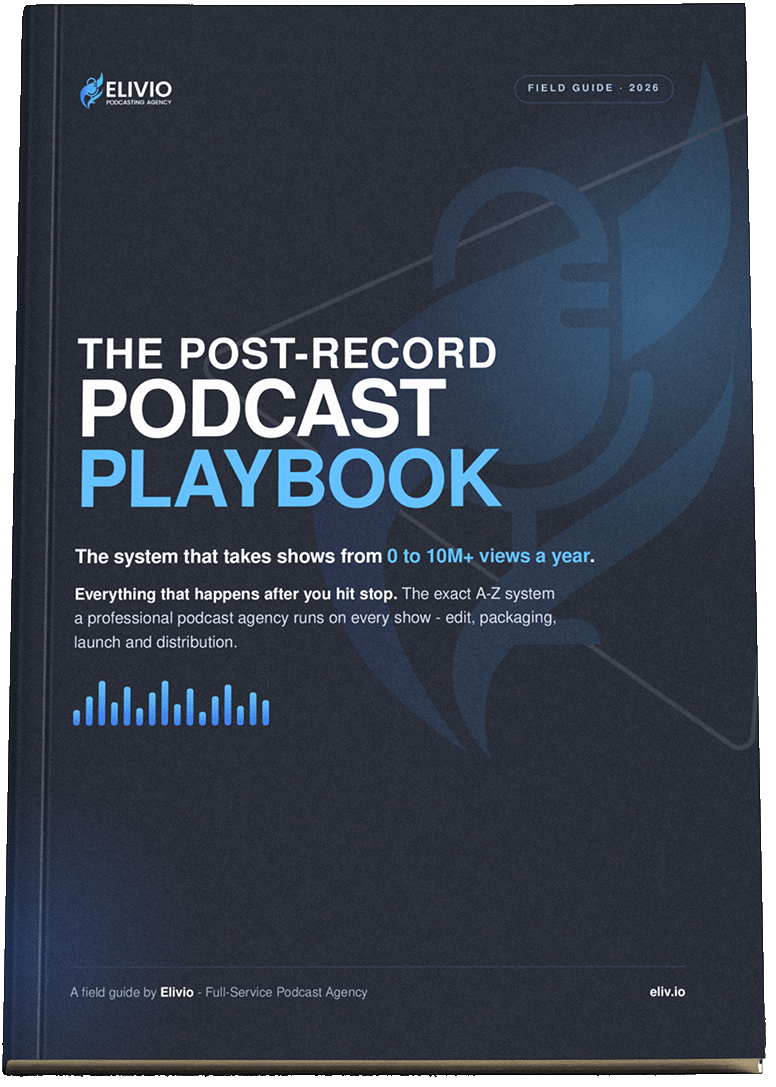
When each step is defined, you can batch it, speed it up, or hand it off – instead of reinventing it weekly. If you want a ready-made version of this, Elivio’s free Post-Record Podcast Playbook maps the entire A-to-Z system on one page, including the editing, packaging, and launch checklist we use to take shows from zero to millions of views a year.
8. Engage your audience and ask them to share
Your existing listeners are your best growth channel – most just need an invitation.
Ask directly. Encourage listeners to invite two or three people to try the show, and reward participation with a shoutout or a small perk. Reply to comments and DMs. Give your most loyal fans something extra: an extended interview, a behind-the-scenes conversation, or your personal take on a hot topic.
There is also a quiet advantage in 2026 that no tactic can replicate. With AI-generated content flooding every platform, being unmistakably you is a competitive edge. Listeners increasingly seek out real voices and real perspectives. Lean into yours – it is the one thing a machine cannot copy.
9. Know when to get help
At some point, growth stops being a knowledge problem and becomes a time problem.
You know you should clip every episode, optimize every title, post daily, and chase guests. But you also have a business to run, and there are only so many hours. This is the exact moment most shows either plateau or fade – not from lack of ideas, but from lack of capacity.
The options are to hire specialists (a video editor, an audio engineer, a designer, a social manager), train yourself into a part-time producer, or hand the whole post-record process to one team. There is no single right answer; it depends on your budget and how much of your week you want back. What matters is recognizing that consistency at scale usually requires more than one person – and building that support before burnout makes the decision for you.
Frequently asked questions
- How long does it take to grow a podcast?
Most podcasts see meaningful growth over 6 to 12 months of consistent publishing, not weeks. The shows that break through are usually the ones that simply outlast the 90% who quit by episode three. Treat the first 20–30 episodes as building a foundation, and expect compounding – not overnight – results. - How many episodes before a podcast takes off?
There is no magic number, but reaching around 30 episodes already places you in the top 1% for longevity. Growth tends to accelerate once you have a back catalog for new listeners to binge and enough clips circulating to keep feeding the top of the funnel. Consistency over that stretch matters more than any single episode. - Do I need video to grow my podcast in 2026?
For most shows, yes. YouTube is now the most-used podcast platform, over half of Americans have watched a video podcast, and video unlocks discovery, thumbnails, and clips that audio-only formats cannot. You can still succeed with audio, but video-first gives your growth engine far more fuel. - How many clips should I make per episode?
Aim for 5 to 10 short clips per episode and spread them across two to three weeks. That gives you enough to post three to four times a week on TikTok, Reels, Shorts, LinkedIn, and Facebook from a single recording, keeping you visible where new listeners actually discover shows. - Why do most podcasts fail?
Most podcasts fail from podfade – they stop publishing – not from bad content. Around 90% quit by episode three, usually because the weekly load of editing, clipping, and distribution becomes unsustainable. A repeatable workflow or outside help is the most reliable defense against burning out. - Is it worth paying for podcast production?
It depends on the value of your time. If editing, clipping, and distribution are the reason you skip weeks, outsourcing often costs less than hiring four separate specialists and protects the consistency your growth depends on. The break-even point is when the hours you save are worth more than the fee.
The bottom line
Growing a podcast in 2026 comes down to two things: getting found and staying consistent. You get found by going video-first, clipping every episode, and writing titles people actually search for. You stay consistent by building a repeatable post-record system so the work never balloons back into a second job.
None of these strategies is complicated. The hard part is doing all of them, every week, without burning out – which is exactly why so few shows do. If you nail the system, you are already ahead of the 90% who fade.
Want the workflow laid out step by step? Grab the free Post-Record Podcast Playbook – it maps the exact A-to-Z process for turning one recording into a full week of content that grows your show.