


To get your podcast recommended by ChatGPT, each episode needs a public web page with readable text that search bots are allowed to crawl. OpenAI says ChatGPT searches the web and cites its sources, and sites that block its search bot are not shown in those answers. Audio sitting only on Spotify and Apple gives ChatGPT very little to point to.
Nobody outside OpenAI, Google and Perplexity has published how their assistants decide which podcast to recommend. So when a business owner asks me how to get their podcast recommended by ChatGPT, I start by separating what is documented from what people are selling as “AI SEO for podcasts”. The first part is short and the second is very long.
At Elivio, my team and I have worked on hundreds of podcasts and run full-service shows for more than 2 years, with 47M+ impressions across all platforms. Everything below comes from official documentation and published studies I opened myself, and where a study is a vendor’s own data, I say so.
What gets your podcast recommended by ChatGPT in the first place?
Access, because access is the only lever OpenAI actually documents. OpenAI says ChatGPT search “will automatically search the web if your question might benefit from information on the web”, that answers using search “will contain inline citations”, and that “any public website can appear in ChatGPT search” as long as you are not blocking OAI-SearchBot. OpenAI also says that sites which opt out of that bot are not shown in ChatGPT search answers.
Perplexity says the same about PerplexityBot and recommends allowing it, and Anthropic says the same for Claude-SearchBot. What I see in practice is that many business sites blocked every “AI bot” last year on a developer’s advice. If that rule covers the search bots, the episode pages are simply not in the room. I would open yourdomain.com/robots.txt and look at whether OAI-SearchBot, PerplexityBot or Claude-SearchBot sit under a Disallow line. OpenAI and Perplexity both say changes take about 24 hours.
Blocking training crawlers is a separate decision, and it does not have to cost you visibility. OpenAI runs GPTBot for training and OAI-SearchBot for search, and you can treat them differently. Spotify does exactly that in its own robots.txt: it blocks training bots like GPTBot and ClaudeBot and explicitly allows OAI-SearchBot, PerplexityBot and Claude-SearchBot on its embed pages, with a comment saying this is so the player can be found in ChatGPT, Claude and Perplexity. Google says its training token, Google-Extended, does not affect inclusion in Google Search.
Does ChatGPT actually listen to your episodes?
Nothing I found says it does. What it does is look things up, and what it finds are web pages. PodSEO, a company that sells podcast AI tracking, asked ChatGPT, Claude, Perplexity and Gemini for recommendations on 849 topics. 79% of the recommendations cited listicle and aggregator sites, and Apple and Spotify pages together got 8.3%. The four assistants recommended different podcasts 71% of the time, and The Tim Ferriss Show came first overall while sitting at number 35 on Apple’s US business chart.
Spotify opened another door on 6 October 2025 by launching its app inside ChatGPT, and it tells users to add “a topic, host, or guest for podcasts” to the prompt. That tells me people are found through the words around the show: the topic, the host’s name and the guests.
Why does a video-only podcast stay invisible to ChatGPT?
Because ChatGPT mostly works from the search results it retrieves. Ahrefs looked at 1.4 million ChatGPT prompts and found that 88.46% of the retrieved URLs came through the search channel and 0.51% through YouTube. The author’s own conclusion is that you need to be in the search selection pool to be cited.
OtterlyAI ran a small test that every podcaster should know about. They published 8 interviews both as YouTube videos and as written articles made from the transcripts. In the first week the articles earned 79.5% of the citations, and ChatGPT, Claude and Copilot cited the video versions 0% of the time. It was a short single-company test, so I read it as a direction and not as a law. Still, the direction is clear enough for a video podcast: an episode that exists only as video does not give ChatGPT a page to cite.
What does an episode page that gets cited look like?
It answers one clear question in plain text. AirOps ran 16,851 queries three times each in ChatGPT and found that pages whose headings matched the query best were cited 41.0% of the time, against roughly 30% for weaker matches. Pages with 4 to 10 subheadings and 500 to 2,000 words did best, and pages over 5,000 words were cited less than pages under 500 words. Ahrefs found that cited titles matched the prompt more closely than non-cited ones, and that results with natural-language URL slugs were cited 89.78% of the time against 81.11% without.
That is why I do not post the raw transcript of a one-hour episode. It is long, it has no headings and it answers no single question. What I do is turn the transcript into an article built around the question the episode answers, write the headings in the words people actually type, and embed the episode on the page. A page at /how-to-price-consulting-services has a better chance than one called /ep-47-final.
Apple creates transcripts automatically for new episodes in English, French, Spanish and German, and the Podcasting 2.0 transcript tag lets you link your own transcript file in the RSS feed. They help listeners inside those apps, but no source I checked documents that ChatGPT or Perplexity read them, so I would never make them the only text. I also check YouTube captions, since YouTube itself warns that automatic captions can misrepresent speech because of accents and jargon, and the worst misheard word is usually the guest’s name.
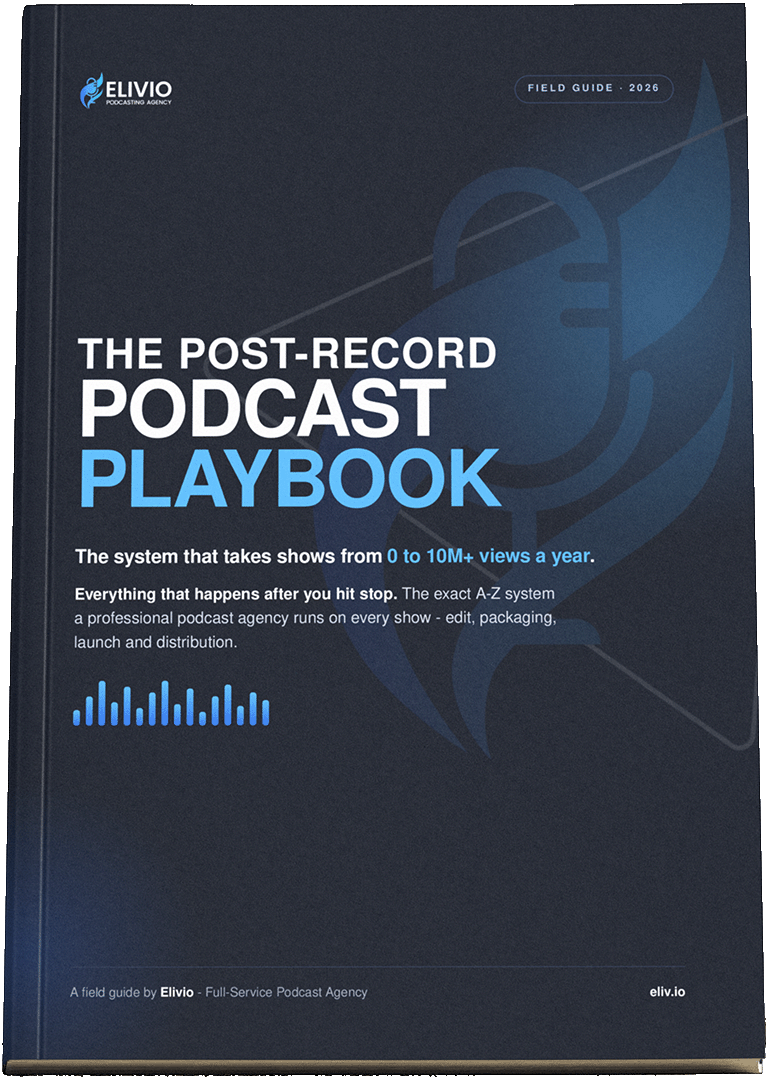
If you want to see how this text layer fits into everything that happens after you hit stop, my free 22-page Post-Record Podcast Playbook walks through the system we use to take shows from 0 to 10M+ views a year.
Does YouTube help your podcast show up in AI answers?
On Google’s side it does. Google says it indexes videos by analysing the visual and audio components, and it asks for a clear title, description and thumbnail on every video. OtterlyAI analysed more than 100 million AI citations and found that 94% of YouTube citations went to long-form videos, with Perplexity accounting for 38.7% of all YouTube citations, AI Overviews 36.6% and ChatGPT only 4.4%. The same study found near-zero correlation between views, likes or subscribers and how often a video was cited, and 40.83% of cited videos had fewer than 1,000 views. For a business podcast with a small channel that is good news.
A Spyglasses study of 5,405 videos cited in Google AI Overviews found that only Google deep-links into moments inside videos, and that longer videos are deep-linked far more often. Only 8.4% of those timestamps landed near a creator’s chapter marker, so chapters are not simply copied, and I still add them because Google’s own video guidance asks for key moments through timestamps in descriptions.
Do you need schema markup or an llms.txt file?
No special file is documented anywhere, and the “up to 40%” GEO boost you see quoted comes from a lab benchmark, not live ChatGPT data. Google Search Central says there are no extra requirements and no special schema needed for AI Overviews and AI Mode, and Google’s John Mueller wrote in June 2025 that “no AI system currently uses llms.txt”, which is one Google employee’s statement and not an official policy. In the AirOps data pages with JSON-LD were cited 38.5% of the time against 32.0% without, and the article calls that effect slight.
How can you tell if AI assistants send you visitors?
OpenAI says ChatGPT adds utm_source=chatgpt.com to its referral links, so if your site allows OAI-SearchBot you can filter for it in your analytics. Microsoft’s AI Performance report in Bing Webmaster Tools shows how often your pages are cited in Copilot and Bing summaries. It does not cover ChatGPT or Google, and Microsoft says it reflects citations, not ranking.
Expect big swings. One agency published 91 days of its own Copilot data and one page took 69% of all citations, while average daily citations fell about 97% from early December to February with no clear reason. Yoast claims that a site missing from Bing will not appear in ChatGPT, but OpenAI only says it may share queries with third-party providers such as Bing, so I treat that as unconfirmed.
Is AI search worth the effort for a podcast?
The traffic is still small. Semrush found that across more than 50,000 websites, AI referrals were about 0.14% of visits in 2025 against 16.04% for organic search, although AI referrals grew 66.02% over the year. Pew’s 2026 survey found that 49% of US adults use AI chatbots and 42% use them to search for information, so the habit is real and growing. Being cited does not guarantee clicks either, since Pew saw people click a traditional result on 8% of visits with an AI summary against 15% without one.
Listeners still find shows mostly on YouTube: Sounds Profitable found that 40% found their favorite podcast there and 12% through internet search. So I treat AI search as a cheap layer on top of work a serious podcast should do anyway. Our Chiflika case study, from 0 to the number one agricultural podcast in Bulgaria in 6 months, shows what consistent podcast post-production does. An episode page and a clean YouTube description just give that work one more place to be found.
If you want to see where your own show stands, I do a free 30-minute podcast audit, and the Post-Record Podcast Playbook is free as well.
FAQ
How do I get ChatGPT to recommend my podcast?
Make sure your website does not block OAI-SearchBot, because OpenAI says blocked sites are not shown in ChatGPT search answers. Then give every episode a public page with readable text, a title that matches what people ask and clear headings. Ahrefs and AirOps both found that titles and headings matching the query get cited more often. Nobody has published how ChatGPT chooses between podcasts.
Should my podcast website block GPTBot or OAI-SearchBot?
They do different jobs. GPTBot is OpenAI’s training crawler, and blocking it means your content should not be used to train models. OAI-SearchBot puts your site into ChatGPT search answers, and blocking it removes you from them. Spotify blocks the training bots and allows the search bots on its embed pages, which is a sensible pattern for a podcast that wants to stay visible.
Do I need a transcript page if my podcast is already on Apple and Spotify?
I would publish one. Apple creates transcripts automatically and Spotify offers them to some shows, but no source documents that ChatGPT or Perplexity read them directly. In OtterlyAI’s small test, written articles made from interview transcripts earned 79.5% of AI citations in the first week, while ChatGPT cited the video versions 0% of the time.